A Philadelphia inspection firm has described walking a buyer through a 1920s rowhome in West Philly and finding something the seller's disclosure had specifically marked as resolved. Active knob-and-tube wiring, still live in the attic, on a form that said the electrical had been updated. The finding gave the buyer real leverage at the negotiating table. It also underscored the limits of relying on a seller's disclosure alone.
The inspection period on an old Philadelphia house is an important opportunity to identify issues.
Age Isn't What Sets Philadelphia Apart
Start with the number everyone already knows. Census data puts the median age of a Philadelphia home at more than 90 years, against roughly 40 nationally, and Pew Charitable Trusts' 2024 State of the City report found the bulk of the city's rowhomes went up between 1880 and 1930. That's the stat every guide leads with, and it's true, but it doesn't actually separate Philadelphia from the rest of this region. A colonial in Doylestown or a twin in Jenkintown carries the same era, the same knob-and-tube, the same galvanized supply lines. Age is a Delaware Valley story, not a Philadelphia one.
What does separate Philadelphia is what happens after that age gets discovered, and specifically, whether anyone was required to look before the buyer's contingency clock started running.
Sewer Lateral Requirements in Nearby Municipalities
A growing number of municipalities around Philadelphia have added a requirement the city itself does not have: a sewer lateral inspection at the point of sale. South Whitehall Township made it mandatory as of January 21, 2026, tying it to the settlement process directly, with the goal of catching cracked or deteriorated laterals before ownership changes hands. Emmaus Borough requires a licensed plumber to inspect and video the lateral before a sale closes, charges $275 if the borough performs it, and issues a certificate valid for two years once the line passes. Plymouth Township expects the process to start as soon as a property is listed, because the inspection and any resulting repair work need to close out within 30 days of settlement. Jenkintown, Ambler, and Upper Darby have their own versions of the same idea, some tied to a flat fee, some tied to which licensed trade is allowed to sign off.
Philadelphia's own plumbing code is clear that the private sewer lateral, the pipe running from the house to the city main, is the homeowner's property and the homeowner's responsibility, not the Water Department's. What the code does not do is fold that responsibility into a resale requirement the way the townships above have. There's no citywide mandate forcing a camera scope or a certificate before a rowhome changes hands. The pipe is just as old as the one in Jenkintown. As a result, a buyer may reach settlement without knowing the lateral's condition.
A failed sewer lateral is not a cosmetic finding. Repair or replacement typically runs $3,000 to $8,000, and standard homeowner's insurance does not cover sewer backup damage without a separate rider, one that usually caps out well below what a real backup can cost in cleanup and repair. In the suburbs that require a pre-sale scope, that risk surfaces on paper before anyone signs anything. In Philadelphia, buyers may need to arrange a sewer camera inspection themselves during the inspection window, because a standard home inspection does not include a sewer camera by default.
What a Rowhome Inspection Actually Turns Up
Once you're past the sewer question, the pattern of what gets flagged on a Philadelphia rowhome report is fairly consistent across neighborhoods, from Fishtown to Graduate Hospital to West Philly. A few categories account for most of what shows up.
| Finding | What drives it | Typical cost range | Negotiable or deal-breaker |
|---|---|---|---|
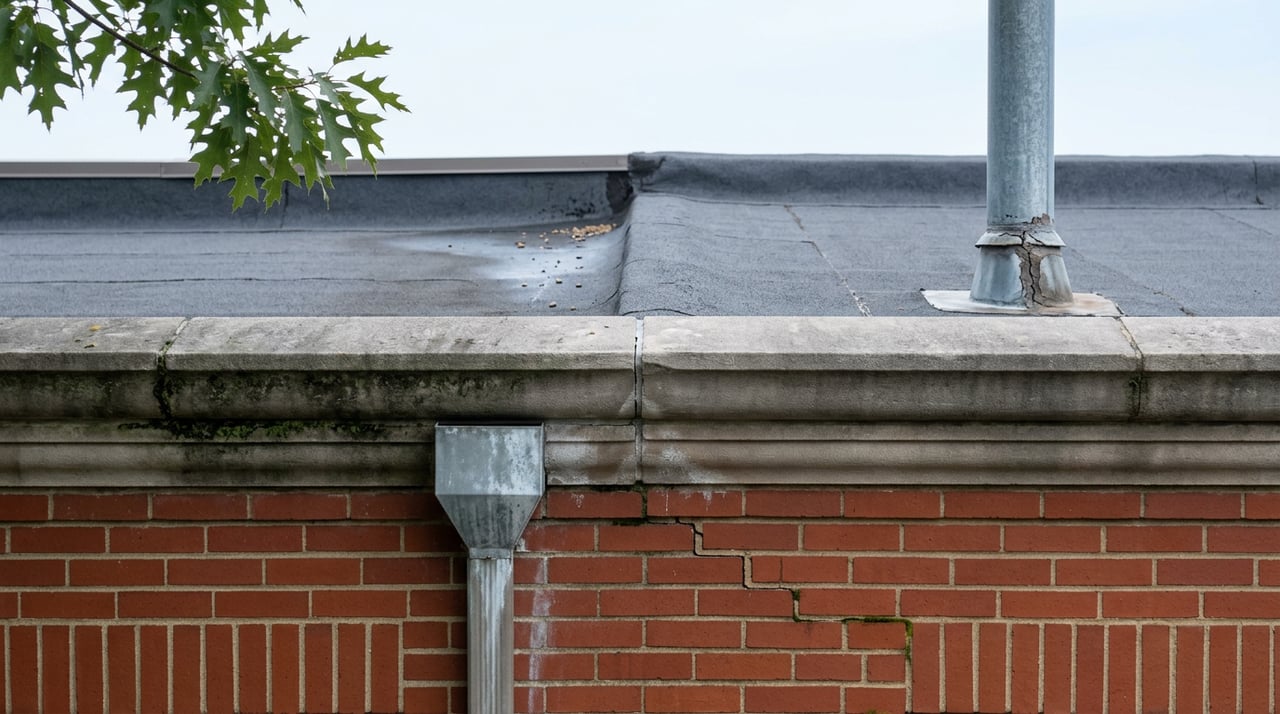
| Flat or low-slope roof failure | Modified bitumen or rubber membranes lasting 15 to 20 years, ponding water, cracked seams | $5,000 to $15,000 | Usually negotiable unless remaining life is under a couple of years |
| Party wall cracking | Adjoining rowhomes settling at different rates, producing step cracks at corners | Varies, engineer review often needed first | Depends on whether it's cosmetic or structural |
| Active basement moisture | Failed grading, blocked downspouts, unwaterproofed pre-war foundation walls | $5,000 to $20,000+ for interior systems | Frequently a deal-killer if intrusion is active, not just a stain |
| Knob-and-tube wiring | Original wiring in homes built before 1940, sometimes buried under later insulation | Full rewire costs vary by scope | Often required by insurers before a policy will be written |
| Lead paint and lead service lines | Pre-1978 paint, plus lead water service lines common in homes built before 1986 and especially before 1950 | Abatement or line replacement costs vary | Propcash notes that lead paint can eliminate FHA or VA financing until resolved |
| Cast iron drain lines | Original drain piping approaching or past its service life | Varies by scope of replacement | Negotiable, but budget-relevant for buyers planning to stay long term |
Party walls sit in a category of their own. An inspector can look at cracking, bulging, or water staining on your side of a shared wall, but has no way to assess what's happening on the neighbor's side, and the wall itself is a shared structural asset that neither owner fully controls. That's a different kind of risk than a suburban buyer with a detached foundation ever has to think through, and it's one more reason a generic home-inspection checklist doesn't map cleanly onto a rowhome.
Why This Year's Negotiating Table Looks Different
The context around these findings has shifted in 2026 in a way that changes what a rowhome buyer should expect once the report lands. Industry data reported in May 2026 showed roughly 22 percent of weekly home sale transactions in the region stalling at the inspection stage, a sharp jump from the same week a year earlier. Roof condition was the single most common trigger, followed by foundation findings, and the reason isn't that houses got older overnight. Spring 2026 brought higher inventory and softer buyer urgency, so a finding that a buyer in 2022 might have absorbed without much discussion is now more likely to produce a pause, a credit request, or a repair demand that takes days or weeks to resolve rather than a same-day handshake.
For a Philadelphia rowhome, that shift lands directly on top of the era-specific issues above. A flat roof with a remaining life under five years, a step crack that turns out to be more than cosmetic, or a sewer lateral nobody scoped before listing are exactly the kind of findings that now stretch a settlement timeline instead of closing quietly.
What This Actually Means for Your Contract
None of this is a reason to walk away from a rowhome. It's a reason to be specific about what you ask for before your inspection contingency runs out. A buyer working a Philadelphia deal in 2026 gets more value out of a targeted sewer camera scope, arranged independently since it typically is not part of a standard inspection, than out of a longer generic checklist. A seller gets more value out of knowing which of these findings are routine negotiation and which ones stop a deal cold, so pricing and disclosure decisions get made before a buyer's inspector finds them first.
That's the part of a rowhome transaction where local pattern recognition actually pays off. Knowing which finding is a five-minute conversation and which one needs a structural engineer before the contingency window closes is the difference between a deal that slows down for a week and one that falls apart entirely.
A Few Questions Worth Settling Upfront
Does Philadelphia require a sewer lateral inspection before a home sale? Not citywide, unlike a growing list of surrounding municipalities including Jenkintown, Ambler, Upper Darby, Emmaus, and South Whitehall Township, which now require a lateral inspection or certificate as part of settlement. Philadelphia's code makes the lateral the owner's responsibility but does not attach a resale certification requirement to it.
What does a typical rowhome inspection cost in Philadelphia right now? Reported ranges for 2026 run roughly $350 to $750 depending on square footage, age, and scope, with multi-unit properties running higher.
What's the single biggest reason deals are stalling this year? Roof condition, followed closely by foundation findings, according to regional inspection data reported in mid-2026.
If you're weighing whether to fix something before you list, or trying to figure out what a finding on your buyer's report actually means for your price, Maria Petrogiannis has walked enough Philadelphia rowhome contracts through exactly this conversation to tell you which fight is worth having. Get your free home valuation and we'll build the negotiating strategy backward from what your specific block, block age, and buyer pool actually require.
This article is general information, not legal, tax or financial advice. Consult a qualified professional about your situation.